|
If all surface temperatures are specified in a problem, the
results from Eq. (A-17) complete the solution. If qk is
specified for n surfaces and Tk for the remaining
N–n surfaces, then the n unknown surface temperatures are guessed,
the equations are solved for all q, and then the calculated qk
are compared to the specified values. If they do not agree, new values of Tk
for the n surfaces are assumed and the calculation is repeated until the
given and calculated qk agree for all Ak
with specified qk. Equation (11-8), expressed as a sum over
the wavelength bands, gives the required energy input to the medium for the
specified Tg.
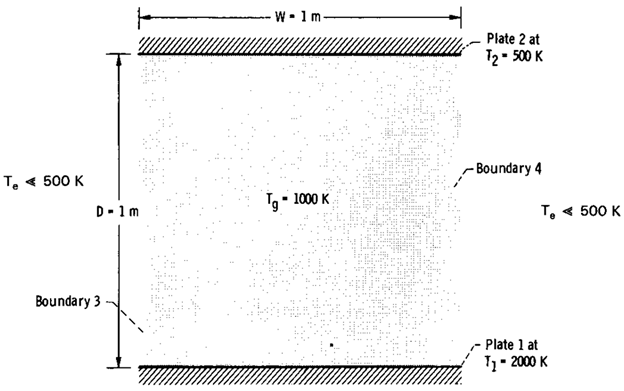
EXAMPLE A-2 Two black
parallel plates are D = 1 m apart. The plates are of width W = 1 m
and have infinite length normal to the cross section shown (Fig. A-9). Between
the plates is carbon dioxide gas at
As shown by Fig. A-9, the geometry is a four-boundary
enclosure formed by two plates and two open planes. The open areas are perfectly
absorbing (nonreflecting) and radiate no significant energy as the surrounding
temperature is low. The energy flux added to surface 2 is found by using the
enclosure equation (10-72) where k = 2 and N = 4. All
surfaces are black, ελ,j
= 1, so Eq.
(10-72) reduces to
The self-view factor F2–2 = 0 and Eλb,3
= Eλb,4
≈ 0, so this becomes
To simplify the example, it is carried out by considering the
entire wavelength region as a single spectral band. To obtain the total energy
supplied to plate 2, integrate over all wavelengths to obtain
By use of the definitions of total transmission and
absorption factors,
and so forth, q2 becomes
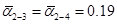
To determine
From factor 3 in Appendix C the F2–1 is
given by
Note that the largest contribution to q2 is
by energy leaving surface 1 that reaches and is absorbed by surface 2. Emission
from the gas to surface 2, and emission from surface 2, are small.
An alternative approach for this particular example is to
note that the term involving Tg in (A-20) is the
flux received by surface 2 as a result of emission by the entire gas. This can
be calculated from (10-114) using the mean beam length. Then
|